Same 2-Litre Jar, 66 Percent More Money
The Bosch VitaPower and Philips 5000 Series share the same 2-litre jug and pulse button, yet the Bosch costs 99 EUR (66 percent) more for 600 extra watts.
By Nora Fischer · Last updated 29 August 2026
Researched and drafted with AI language-model assistance from CompareHomeAppliances' own verified spec database and cited public sources, per our AI-content disclosure.
The Bosch VitaPower MMB6762M and the Philips 5000 Series HR3041 hold the same 2.0-litre jar, both carry a pulse function, and both list dishwasher-safe parts, according to each brand’s own product page. Buy the Bosch and the receipt reads 249.00 EUR. Buy the Philips and it reads 149.99 EUR. That is a 99.01 EUR gap, 66 percent more for the Bosch, on a jar that measures exactly the same on both spec sheets.
Key takeaways:
- The Bosch VitaPower MMB6762M and Philips 5000 Series HR3041 match on jar size (2.0 L), pulse function, and dishwasher-safe parts, yet the Bosch costs 99.01 EUR (66 percent) more: 249.00 EUR versus 149.99 EUR.
- The disclosed difference is 600 extra watts (1800W vs 1200W) and a published 85 dB noise reading on the Bosch; Philips does not publish a noise figure at all.
- Among the four full-size jug blenders in our dataset, the cheapest place to add power is the step from the Philips (1200W) to the Braun PowerBlend 9 JB9040 (1600W): 0.07 EUR per extra watt.
- The next step, Braun to Bosch, costs 0.35 EUR per extra watt, five times the Philips-to-Braun rate, for 200 extra watts.
- Blenders do not appear on the European Commission’s own product list for energy labelling, so there is no A-to-G rating to check here, unlike washing machines or dishwashers.
What does the extra 99 euros actually buy?
On paper the Bosch and Philips are the closest possible pair in our dataset: identical 2.0-litre stainless jug, identical pulse button, identical dishwasher-safe claim on parts. The confirmed difference is power, 1800W against 1200W, 600 watts or 50 percent more, and a disclosed noise figure. Bosch states 85 decibels on its own product page, the single loudest reading anywhere in this five-model dataset. Philips simply does not publish a noise figure, so the two cannot be compared directly on sound. “Not disclosed” is not the same as “quieter.”
Blade material tells a similar story. Bosch names stainless steel. Philips’s own page does not state a blade material at all, an undisclosed spec, not a confirmed difference. Assume nothing about a spec the manufacturer hasn’t written down.
| Model | Type | Price (EUR) | Power (W) | Jar capacity (L) | Noise (dB) | Blade material | Dishwasher-safe parts |
|---|---|---|---|---|---|---|---|
| Bosch VitaPower MMB6762M | Jug | 249.00 | 1800 | 2.0 | 85 | Stainless steel | Yes |
| Braun PowerBlend 9 JB9040 | Jug | 179.00 | 1600 | N/A | N/A | Stainless steel | Yes |
| Philips 5000 Series HR3041 | Jug | 149.99 | 1200 | 2.0 | N/A | N/A (undisclosed) | Yes |
| Kenwood Blend-X BLP41 | Jug | 61.90 | 650 | 1.5 | N/A | Stainless steel | N/A (undisclosed) |
| WMF Kult X Mix Go | Personal | 39.99 | 300 | 0.6 | N/A | Stainless steel | No |
Note: the WMF Kult X Mix Go is a 0.6-litre personal blender, not a smaller jug blender. It’s shown here for completeness but excluded from the jug-only wattage comparisons above and below.
Put the 99.01 EUR gap next to something concrete: it is more than the entire price of the Kenwood Blend-X BLP41 (61.90 EUR), with 37.11 EUR left over. That is the real size of the premium, not “a bit more,” but enough to buy a second, complete blender and still have change.
Where does an extra watt cost the least?
The WMF Kult X Mix Go is a 0.6-litre personal blender built for single servings, not a smaller jug blender, the same reason earlier comparisons on this site set aside pod-capsule coffee machines when ranking brewers by cost per cup. That leaves four jug blenders: the Kenwood Blend-X BLP41 (650W, 61.90 EUR), the Philips 5000 Series HR3041 (1200W, 149.99 EUR), the Braun PowerBlend 9 JB9040 (1600W, 179.00 EUR), and the Bosch VitaPower MMB6762M (1800W, 249.00 EUR).
Line them up by power and look at what each extra watt costs, stepping from one to the next.
The middle step is the bargain. Going from the Philips up to the Braun buys 400 extra watts for 29.01 EUR, 0.07 EUR per watt, the cheapest rate on the ladder, even though the Braun’s own sticker price (179.00 EUR) is higher than the Philips’s (149.99 EUR). Watt for euro, the Braun beats the Philips despite costing more outright.
The step before it, from the entry-level Kenwood up to the Philips, runs 0.16 EUR per watt, more than double the Braun rate. And the last step, from the Braun up to the Bosch, is the outlier: 70.00 EUR for 200 watts, 0.35 EUR per watt, five times what the Philips-to-Braun step costs. The same pattern shows up in flat EUR-per-100W terms: Kenwood 9.52, Braun 11.19, Philips 12.50, Bosch 13.83 EUR per 100 watts, Braun again undercutting Philips.
If you already own something underpowered and want a real step up, the Braun PowerBlend 9 is the efficient place to stop. The jump beyond it to the Bosch buys wattage at a steep premium, and the only other thing it clearly buys over the Braun is a disclosed, not necessarily better, noise figure.
Is a bigger jar always better?
Only within the same format. Jar capacity only means the same thing when you’re comparing like for like: the Bosch and Philips both hold 2.0 litres as jug blenders, the Kenwood holds 1.5 litres as a smaller jug blender, and the WMF holds 0.6 litres as a personal blender built to blend and drink from the same cup, not to fill a jug for a family. Comparing the WMF’s 0.6 litres against the Bosch’s 2.0 litres the same way you’d compare two jugs treats a different kind of tool as a smaller version of the same one. Compare jar size only inside its own format: jug against jug, personal against personal.
Does the EU energy label apply to blenders?
No. Search the European Commission’s own Ecodesign and energy-label product list and blenders are not on it. Dishwashers, hobs, washing machines and several other categories carry a mandatory A-to-G rating; blenders, like coffee machines, irons and toasters, do not. Our guide to reading the EU energy label covers why that letter only ranks appliances inside one category, and it’s a moot point here anyway: no rating exists to check, so the wattage, price, and disclosed spec sheet are the only real evidence a blender shopper has.
Compare the current lineup for yourself at /blenders/ before deciding whether the extra 99 euros, or the extra 200 watts past the Braun, is worth it for what you actually blend.
Appliances in this analysis
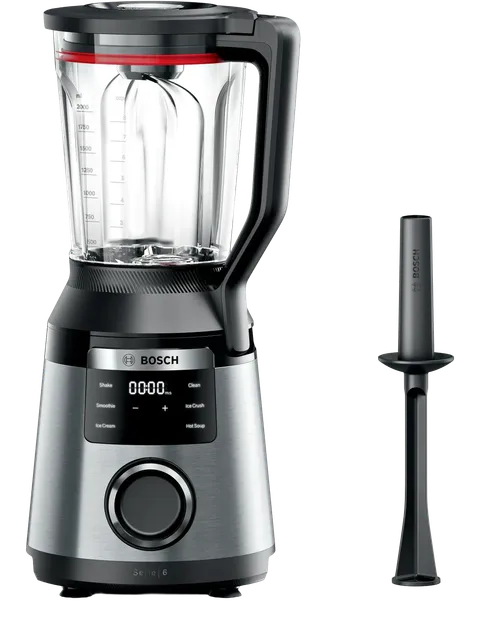
Bosch
VitaPower Serie 6 MMB6762M
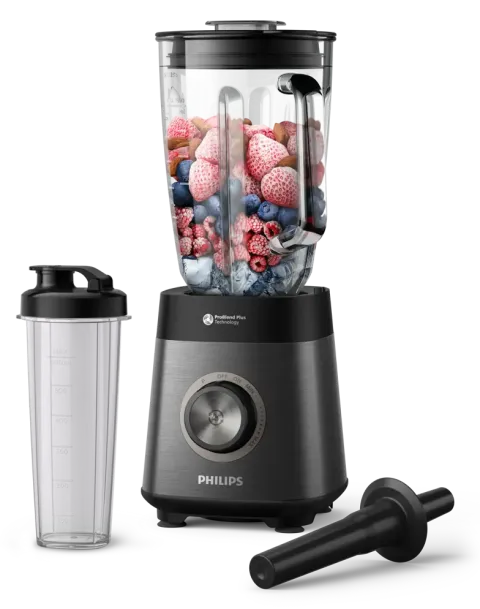
Philips
5000 Series HR3041/00
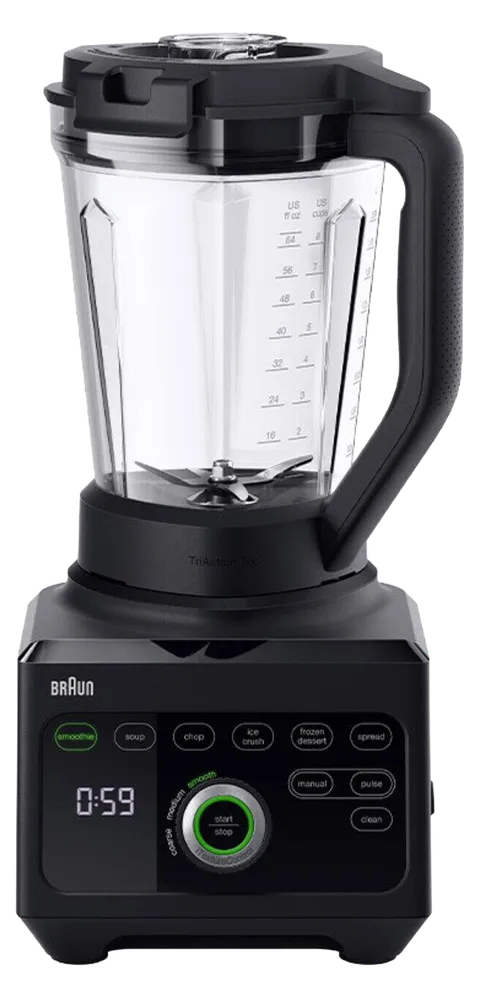
Braun
PowerBlend 9 JB9040BK
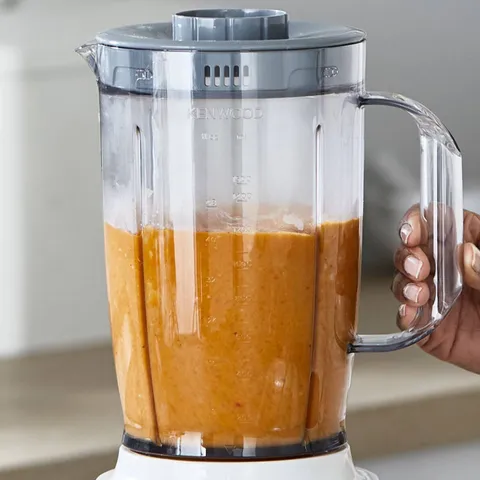
Kenwood
Blend-X BLP41.A0WH
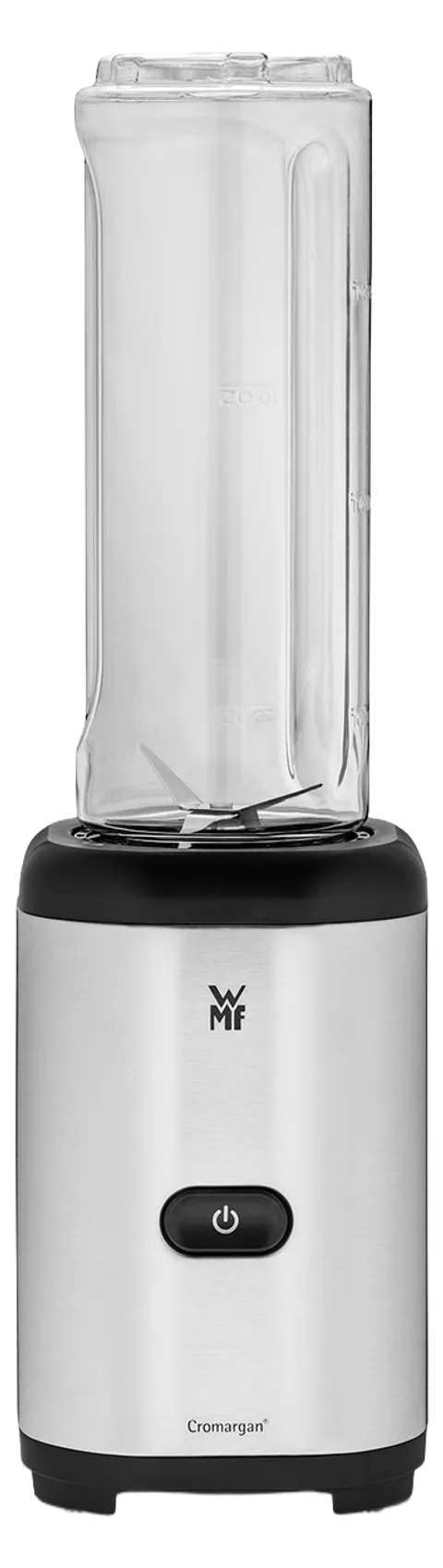
WMF
Kult X Mix & Go
Related categories
Frequently asked questions
Does the EU energy label apply to blenders? +
No. Blenders do not appear anywhere in the European Commission's own Ecodesign/energy-label product list (energy-efficient-products.ec.europa.eu/product-list_en), which covers categories like dishwashers, hobs and washing machines but has no blender or food-processor entry. There is no A-to-G rating to compare on a blender, the same situation as coffee machines, irons and toasters.
Does a bigger jar always mean a better blender? +
Only within the same format. The WMF Kult X Mix Go is a 0.6-litre personal blender built for single servings, not a smaller version of a 2-litre jug blender, compare jar size only within the same type.
Does higher wattage mean a better blender? +
More power generally means faster or heavier-duty blending, but in our own dataset the price you pay for each extra watt is wildly uneven from one price tier to the next, not a steady rate, see the chart below.
What's the real difference between the Bosch VitaPower and the Philips 5000 Series blender? +
Both are 2-litre stainless-jug blenders with a pulse function and dishwasher-safe parts. The disclosed difference is 600 watts more power and a published 85-decibel noise figure on the Bosch, for 99.01 EUR (66 percent) more.
Sources
More from the blog