Hood Airflow and Noise Are Quoted at Different Settings
Miele quotes 650 m3/h and Bosch 431 m3/h, but that is boost against top normal stage. Like for like: 395 vs 431 (normal) and 650 vs 768 (boost).
By Nora Fischer · Last updated 19 September 2026
Researched and drafted with AI language-model assistance from CompareHomeAppliances' own verified spec database and cited public sources, per our AI-content disclosure.
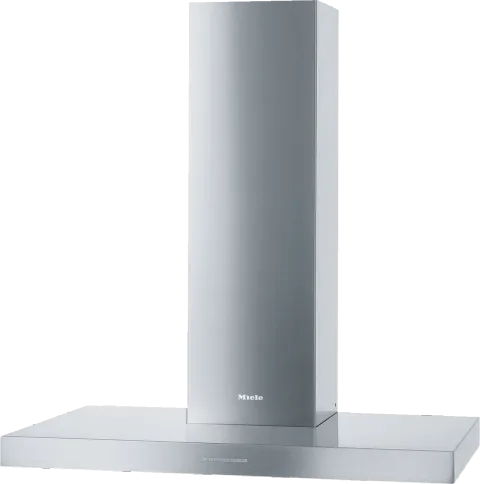
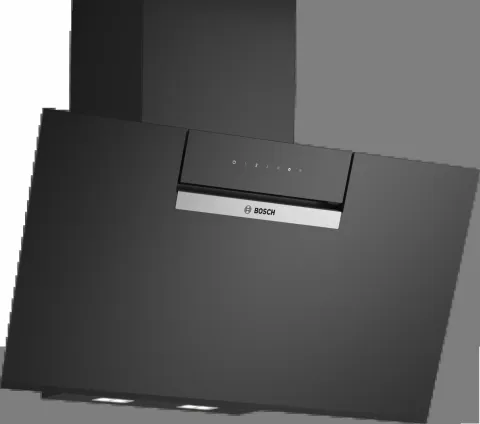
Put the Miele PUR 98 W’s 650 m3/h next to the Bosch DWK87FN60’s 431 m3/h and the Miele looks like it moves about half as much air again. It does not. The 650 is Miele’s booster stage, the 431 is Bosch’s highest normal stage. On the same footing the normal stages read 395 (Miele) against 431 (Bosch) and the boost stages 650 against 768. Before comparing two hoods, check which setting each airflow number belongs to.
Key takeaways:
- Miele’s PUR 98 W quotes 395 m3/h at its highest normal stage and 650 m3/h at booster; Bosch’s DWK87FN60 quotes 431 and 768 (its intensive stage), so Bosch is 9.1% ahead at normal and 18.2% ahead at boost.
- Across 17 Bosch hoods, airflow at the intensive stage runs 412 to 1007 m3/h (2.4x), but sound power at that same stage stays within 65 to 70 dB, and 12 of the 17 read exactly 68 dB.
- The weakest Bosch hood (DFL094A51, 412 m3/h) and the strongest (DWK91LT60, 1007 m3/h) both read 70 dB sound power at the intensive stage.
- Three Miele PUR hoods share the same 650 m3/h booster airflow and class A but cost 769, 869 and 1,549 EUR; the 680 EUR (78.3%) step from the 90 cm wall hood to the island hood buys mounting style, not airflow.
- The annual electricity gap between the cheapest and dearest of the three is 4.8 kWh, about 1.92 EUR a year at 0.40 EUR per kWh.
Why does Miele say 650 and Bosch 431?
Miele’s page for the PUR 98 W lists airflow per stage under EN 61591: 265, 320 and 395 m3/h for stages 1 to 3, then 650 m3/h at booster. (The page also lists a lower set topping out at 460 m3/h at booster; we compare the higher set from each maker.) Bosch’s DWK87FN60 page lists 431 m3/h at its highest normal stage and 768 m3/h at its intensive stage, both in exhaust mode.
Our own database stores Miele’s booster figure but Bosch’s highest-normal-stage figure as the “extraction rate”, so a straight comparison of the stored numbers flips the result. It is a labelling difference in how each maker prints its headline, not a fault of either hood, and we have flagged our data for correction.
| Hood | Airflow, highest normal stage (m3/h) | Airflow, boost or intensive stage (m3/h) | Sound power at boost (dB) |
|---|---|---|---|
| Miele PUR 98 W | 395 | 650 | 67 |
| Bosch DWK87FN60 | 431 | 768 | 68 |
Both sound-power figures are at boost. Boost is a short-burst setting (Bosch’s own page says its intensive stage switches back to normal speed by itself after a few minutes); normal stage is what runs while you cook.
Does noise change when you compare like with like?
Only one detail of our earlier post changes. Our earlier post on Bosch extraction rate and noise paired each hood’s highest-normal-stage airflow with its noise reading, but that reading is sound power at the intensive stage (exhaust mode), so two different settings sat in one comparison.
We re-read all 17 Bosch pages and paired intensive airflow with intensive sound power. The broad finding survives: a 2.4x airflow range inside a 5 dB band. One claim does not: the earlier post said the most powerful hood ties for the quietest. At matched stage the strongest, the DWK91LT60 at 1007 m3/h, ties for the loudest at 70 dB, as does the weakest, the DFL094A51 at 412 m3/h. The two quietest, at 65 dB, are the DLN87AC50 (745 m3/h) and DWK85DK60 (550 m3/h); 12 hoods sit at 68 dB, 3 at 70 dB and 2 at 65 dB. We have corrected the earlier post.
| Model | Type | Airflow, highest normal stage (m3/h) | Airflow, intensive stage (m3/h) | Sound power, intensive stage (dB) |
|---|---|---|---|---|
| DFL094A51 | Integrated | 266 | 412 | 70 |
| DWK85DK60 | Wall-mounted | 430 | 550 | 65 |
| DHL555BM | Integrated | 460 | 604 | 68 |
| DHL755BM | Integrated | 468 | 614 | 68 |
| DLN56AC50 | Integrated | 570 | 645 | 68 |
| DWB67DN60 | Wall-mounted | 399 | 699 | 68 |
| DWB97DN60 | Wall-mounted | 399 | 699 | 68 |
| DBB67DP60 | Integrated | 433 | 699 | 68 |
| DBB97DP60 | Integrated | 433 | 699 | 68 |
| DFS067K51 | Integrated | 392 | 717 | 68 |
| DFR067A52 | Integrated | 399 | 728 | 68 |
| DLN87AC50 | Integrated | 600 | 745 | 65 |
| DWK67FN60 | Wall-mounted | 431 | 768 | 68 |
| DWK87FN60 | Wall-mounted | 431 | 768 | 68 |
| DRC97AQ50 | Ceiling | 459 | 798 | 68 |
| DRC99PS20 | Ceiling | 459 | 933 | 70 |
| DWK91LT60 | Wall-mounted | 441 | 1007 | 70 |
Airflow does not separate a loud hood from a quiet one at boost. Compare the boost noise figure directly, and remember it describes the loudest setting, not everyday cooking.
What do the extra euros on a Miele hood buy?
On Miele’s own pages, all three hoods are class A (Miele’s A+++ to D scale) with a 650 m3/h booster stage.
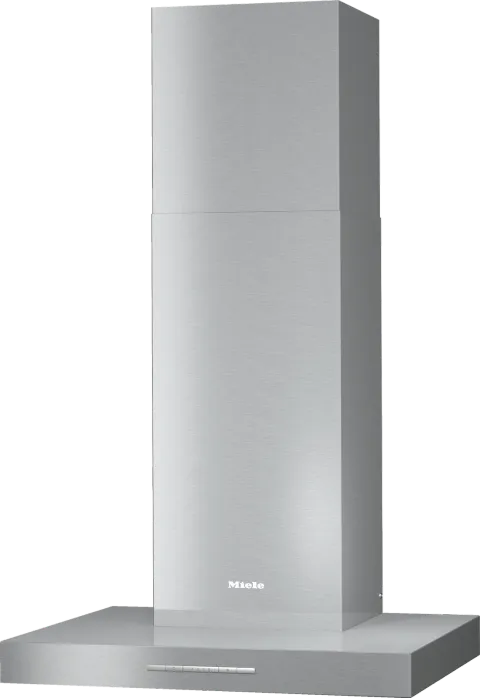
- PUR 68 W: wall hood, body 598 mm wide, 769 EUR, 2 dishwasher-safe grease filters, 2 x 3 W LEDs (330 lx), 21 kg, 47 kWh a year.
- PUR 98 W: wall hood, body 898 mm wide (300 mm wider, +50.2%), 869 EUR (+100 EUR, +13.0% on the 68 W), 3 grease filters, 3 x 3 W LEDs (450 lx), 25 kg, 49.7 kWh a year. Airflow matches the 68 W at every stage (265, 320, 395 and 650 m3/h), and so does sound power (67 dB).
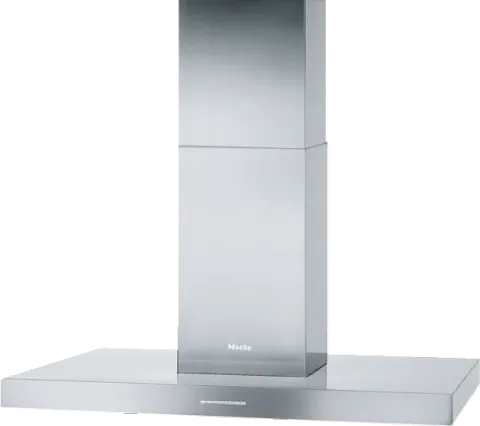
- PUR 98 D: island hood, body 898 x 70 x 598 mm (the wall hood is 898 x 62 x 500), 1,549 EUR, 3 grease filters, 4 x 3 W LEDs (500 lx), 34 kg, 51.8 kWh a year. Stage 3 airflow is 400 m3/h (against 395), booster is the same 650, sound power at booster is 69 dB (against 67) and sound pressure at booster is 51 dB (against 52).
The island hood costs 680 EUR (78.3%) more than the 90 cm wall hood and 780 EUR more than the 68 W, a bit over double (2.01x). Per m3/h of booster airflow that is 1.18, 1.34 and 2.38 EUR (68 W, 98 W, 98 D). Prices are Miele’s own list prices, read on 2026-09-19.
| Hood | Mounting | Body width (mm) | Price (EUR) | Airflow, highest normal stage (m3/h) | Airflow, booster (m3/h) | Sound power at booster (dB) | Annual energy (kWh) |
|---|---|---|---|---|---|---|---|
| Miele PUR 68 W | Wall | 598 | 769 | 395 | 650 | 67 | 47 |
| Miele PUR 98 W | Wall | 898 | 869 | 395 | 650 | 67 | 49.7 |
| Miele PUR 98 D | Island | 898 | 1,549 | 400 | 650 | 69 | 51.8 |
The 68 W to 98 W step is mostly width (30 cm), a third filter and more light; the step to the island version is the mounting format. If your hob sits on an island, a wall hood cannot do the job, so the 680 EUR is the price of the layout, not of extra performance. Against a wall, the wall version gives the same airflow for 680 EUR less. Miele does not say why the island unit costs more.
Running cost does not change this: the 68 W to 98 D gap is 4.8 kWh a year, about 1.92 EUR at 0.40 EUR per kWh (the site’s own assumption, see the running-cost tool), less than one coffee.
How should you compare two hood spec sheets?
Four checks:
- Find the stage behind the airflow number. Compare highest normal stage with highest normal stage, boost with boost.
- Take noise from the same stage. Prefer sound power in dB(A) re 1 pW when both makers print it. Miele’s page also prints sound pressure at booster (52 dB against 67 dB sound power for the same PUR 98 W), so the two kinds of dB number are not interchangeable.
- Look at what the price buys. In the Miele trio, mounting format and width moved the price more than airflow did.
- Put the two side by side in the comparison tool, or narrow the field with the appliance advisor.
Weighing a downdraft hob instead? See hob with built-in extractor versus a separate hood.
Scope: Bosch figures come from 17 Bosch product pages read on 2026-09-19, Miele figures from 3 Miele pages; other makers are not covered. To check your own shortlist at the same two stages, start from the extractor hoods category.
Appliances in this analysis
Miele
PUR 98 W
Miele
PUR 98 D
Miele
PUR 68 W
Bosch
Serie 4 DWK87FN60
Bosch
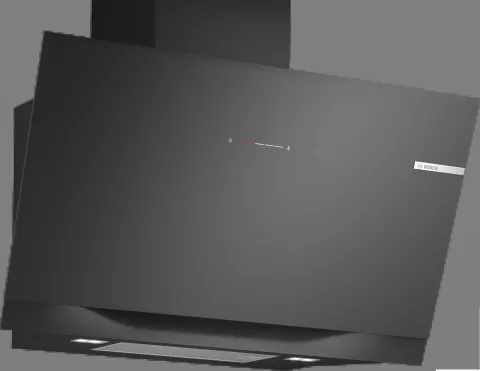
Serie 8 DWK91LT60
Bosch
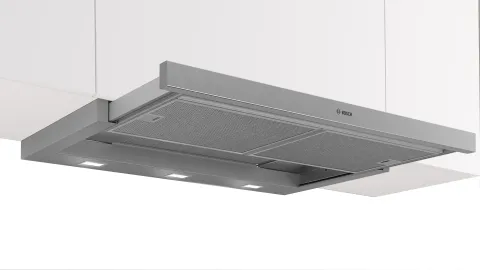
Serie 4 DFL094A51
Related categories
Frequently asked questions
Why do Miele and Bosch hoods quote such different airflow numbers? +
Because the headline figure belongs to different settings. Miele's PUR 98 W is listed at 650 m3/h, which is its booster stage, while Bosch's DWK87FN60 is listed at 431 m3/h, which is its highest normal stage. On the same footing the Miele moves 395 m3/h at its top normal stage and 650 at booster, and the Bosch moves 431 and 768 (its intensive stage).
Does a more powerful hood have to be louder? +
Not on the evidence of 17 Bosch hoods. At the intensive stage their airflow runs from 412 to 1007 m3/h, yet sound power stays between 65 and 70 dB. The weakest hood (DFL094A51) and the strongest (DWK91LT60) both read 70 dB.
Why does the Miele PUR 98 D island hood cost 680 EUR more than the PUR 98 W? +
It is the island version of the same hood: both quote 650 m3/h at booster and class A. The island unit has 4 LEDs against 3, weighs 34 kg against 25 kg, and reads 69 dB sound power at booster against 67 dB. Miele does not say why the island unit costs more, so the honest reading is that the extra money buys the mounting format, not airflow.
What is the difference between sound power and sound pressure on a hood spec sheet? +
Sound power describes the hood itself, sound pressure is a reading at a listening position. Miele's PUR 98 W page lists both at booster: 67 dB(A) re 1 pW per EN 60704-3 (power) and 52 dB(A) re 20 uPa per EN 60704-2-13 (pressure). Do not compare one maker's power figure with another maker's pressure figure.
Sources
More from the blog