A Longer Battery Doesn't Mean a Bigger Dust Bin
Samsung's Bespoke Jet AI runs 67 percent longer than Dyson's V15 at a similar price, but Dyson's dust bin holds 54 percent more before you empty it.
By Nora Fischer · Last updated 19 July 2026
Researched and drafted with AI language-model assistance from CompareHomeAppliances' own verified spec database and cited public sources, per our AI-content disclosure.
Samsung’s Bespoke Jet AI VS28C9784QK runs for 100 minutes on a charge, 67 percent longer than the Dyson V15 Detect Absolute’s 60 minutes, and it costs only 4.3 percent less: 625 EUR against Dyson’s 599 EUR. On runtime alone, Samsung looks like the clear win at a near-identical price. But open the two machines up and the trade-off flips: Dyson’s dust bin holds 0.77 litres, 54 percent more than Samsung’s 0.50 litres, and Dyson discloses sealed HEPA filtration where Samsung’s own listing does not. A longer battery does not buy you a bigger bin, and in a large or heavily-shedding home, the bin can empty its patience before the battery does.
Key takeaways:
- Among the four cordless stick vacuums in our comparison, three report exactly 60 minutes of runtime; Samsung’s Bespoke Jet AI VS28C9784QK is the outlier at 100 minutes, 67 percent longer.
- Samsung (625 EUR) and Dyson (599 EUR) sit only 4.3 percent apart in price, yet their runtimes differ by 67 percent and their bin sizes differ by 54 percent in the opposite direction.
- Dyson’s V15 Detect Absolute holds 0.77L of dust before emptying, the largest bin of the four, and is the only one of the pair with disclosed sealed HEPA filtration.
- Shark’s Stratos IZ400UK is both the cheapest stick vacuum here (239 EUR) and has by far the smallest bin (0.19L), a coherent budget-tier trade-off rather than an oversight.
- Miele’s Triflex HX2 (729 EUR) matches Samsung’s 0.50L bin but runs only 60 minutes and, at 87dB, Samsung is the loudest machine in the entire set, with Miele close behind at 77dB.
Does a longer runtime make Samsung the better buy?
Not automatically. A battery number tells you how long a single charge lasts before the vacuum shuts off; a bin number tells you how long you can keep cleaning before you have to stop, empty it, and continue. Those are two separate limits on how long you can actually vacuum in one go, and a machine only cleans as long as whichever limit hits first.
At 100 minutes of runtime, the Samsung Bespoke Jet AI VS28C9784QK comfortably outlasts the Dyson V15 Detect Absolute on paper, and it does so for 26 EUR less. If your home is small enough, or your carpets clean enough, that the 0.50L bin never fills before the vacuum needs recharging anyway, Samsung’s extra 40 minutes is pure upside: fewer charging interruptions for the same money.
But runtime and bin capacity solve different problems, and the household that benefits from a long runtime is often exactly the household that fills a bin fast: more square metres, more pet hair, more debris per pass. In that case, the machine’s real working session is capped by whichever runs out first, and for Samsung, the bin may hit its limit well before the battery does.
What are you giving up for that extra 40 minutes?
Bin capacity and filtration. Dyson’s 0.77L bin holds 54 percent more debris than Samsung’s 0.50L bin before you have to stop and empty it, and Dyson’s listing states sealed HEPA filtration, meaning fine dust and allergens are captured rather than recirculated. Samsung’s own product listing does not disclose HEPA filtration at all, which does not necessarily mean it lacks any filtration, but it does mean we cannot confirm the same standard, and under our public-data-only rule, an undisclosed spec is treated as unconfirmed rather than assumed.
So the honest version of this trade-off is: Samsung buys you a longer single session and a slightly lower price; Dyson buys you a bigger buffer before you have to interrupt that session, plus a disclosed filtration standard that matters if allergies are a factor in your household. Neither fact makes one machine wrong. A vacuum with a long runtime but a small bin can still leave you standing at the bin mid-clean in a large home, which defeats part of the point of a long battery in the first place.
| Model | Runtime (min) | Dust bin (L) | Price (EUR) | Noise (dB) | Sealed HEPA |
|---|---|---|---|---|---|
| Shark Stratos IZ400UK | 60 | 0.19 | 239.00 | N/A | Not disclosed |
| Dyson V15 Detect Absolute | 60 | 0.77 | 599.00 | N/A | Yes |
| Miele Triflex HX2 | 60 | 0.50 | 729.00 | 77 | Yes |
| Samsung Bespoke Jet AI VS28C9784QK | 100 | 0.50 | 625.00 | 87 | Not disclosed |
| Roborock S8 MaxV Ultra | N/A (dock-based) | N/A (auto-empty dock) | 1,499.00 | N/A | N/A |
Why is the cheapest model also the smallest bin?
Because the Shark Stratos IZ400UK is priced at 239 EUR, 60 percent cheaper than the Dyson V15, and its 0.19L bin, less than a quarter of Dyson’s 0.77L, is the clearest and most honest trade-off in this comparison. Shark is not hiding a weak spec behind marketing; it is a budget-tier machine that keeps the price down and, like Samsung, does not disclose sealed HEPA filtration. Runtime is the same 60 minutes as Dyson and Miele, so Shark is not cutting corners there either. The compromise is concentrated entirely in the bin: a small tank that needs emptying often on anything beyond a quick tidy-up.
For someone who vacuums in short bursts, a hallway here, a set of stairs there, a 0.19L bin rarely becomes a real obstacle, because the session ends before the bin would anyway. For someone doing a full-home clean in one pass, a 0.19L bin means several stops to empty it, which is the price of the 239 EUR entry point.
What does 77dB versus 87dB actually mean day to day?
Only two of the four cordless models disclose a noise figure, and the gap between them is notable. The Miele Triflex HX2, the most expensive stick vacuum here at 729 EUR, runs at 77dB, roughly the loudness of a normal vacuum cleaner at a few metres. The Samsung Bespoke Jet AI VS28C9784QK runs at 87dB, the loudest machine in this entire comparison and noticeably louder in practice, since the decibel scale is logarithmic. Samsung matches Miele’s 0.50L bin but pairs its longer runtime with the highest disclosed noise level of the group, worth weighing if you vacuum around sleeping children, home offices, or shared walls. Dyson and Shark do not publish a noise figure at all, so we cannot compare them on this measure and treat the field as N/A rather than assume either is quiet.
Is the Roborock S8 MaxV Ultra a fair comparison here?
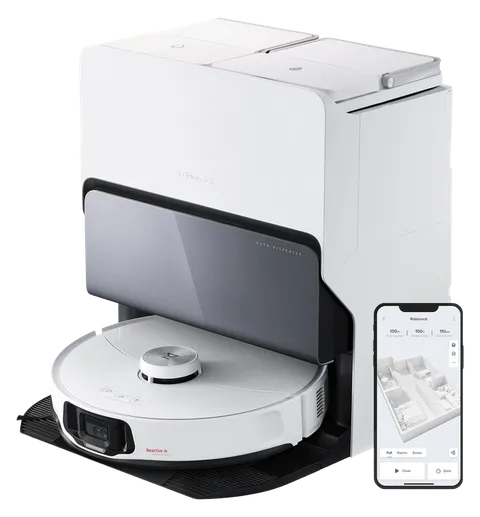
No, and treating it as one would be misleading. The Roborock S8 MaxV Ultra, at 1,499 EUR, is a robot vacuum with a self-emptying dock, not a handheld you carry from room to room on a fixed battery charge. Its runtime is not battery-limited in the same way a stick vacuum’s is, since it docks, recharges, and resumes cleaning on its own schedule, and its bin size is effectively replaced by the dock’s autoEmptyDock feature, which empties the robot automatically after each run. That is the honest answer to the question a dust bin size is trying to answer for a stick vacuum: how often do you have to personally intervene. For Roborock, the dock absorbs that job almost entirely, so comparing its onboard capacity against Dyson’s 0.77L or Shark’s 0.19L would compare two different systems as if they were the same kind of measurement.
Which one should you actually buy?
There is no single winner here, only a match between the machine and the home. If your space is compact and your main goal is finishing a clean without a mid-session recharge, Samsung’s 100-minute runtime at 625 EUR is hard to beat, so long as you are comfortable with an undisclosed filtration spec and the loudest operation of the group. If you have a larger home, pets, or care about disclosed sealed HEPA filtration, Dyson’s 0.77L bin and 599 EUR price make it the steadier choice, even with a shorter 60-minute runtime. If budget is the deciding factor and you clean in short sessions, Shark’s 239 EUR price and 60-minute runtime are competitive, provided you accept emptying that 0.19L bin more often. And if you would rather not think about either number at all, Roborock’s dock-based approach trades the whole runtime-versus-bin question for a different one: whether a 1,499 EUR robot fits your floor plan and your budget.
Browse the full vacuum cleaners category for the complete spec set on each of these models, or put any two of them head to head on our compare page to see runtime, bin size, price, and noise side by side before you decide.
Appliances in this analysis
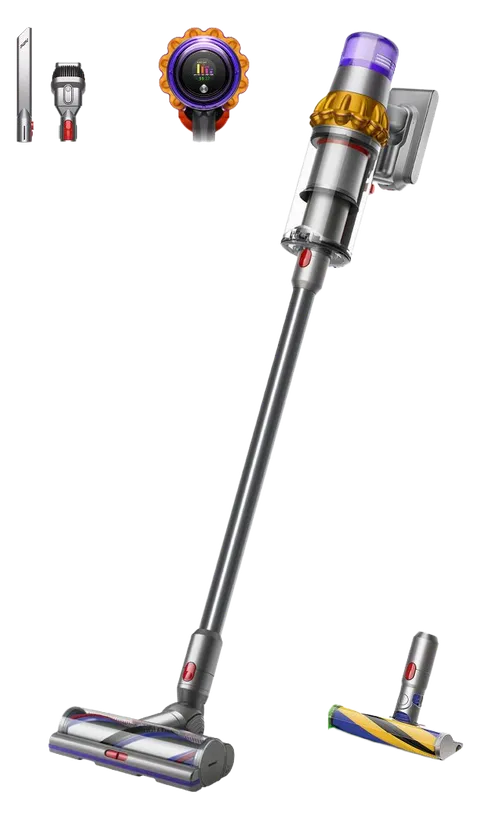
Dyson
V15 Detect Absolute
Miele
Triflex HX2 Sprinter
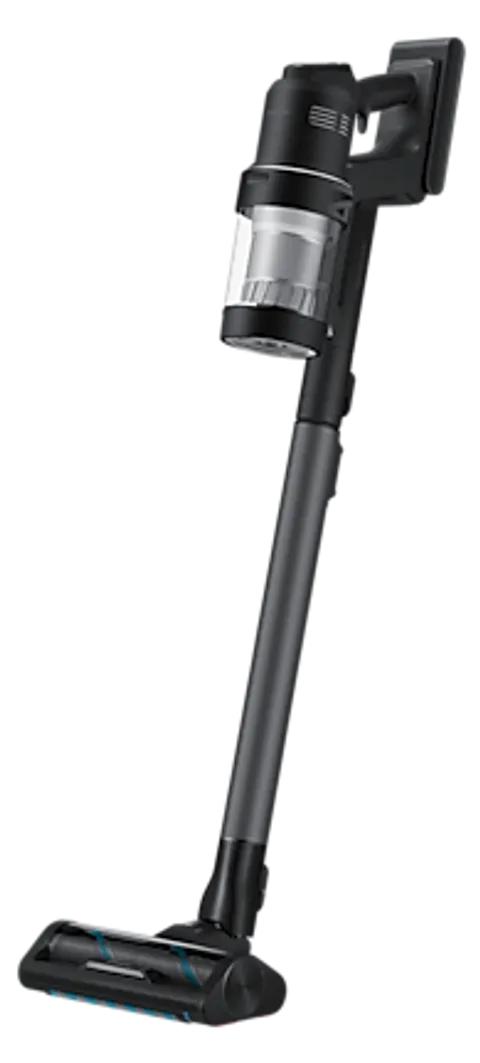
Samsung
Bespoke Jet AI VS28C9784QK/WA
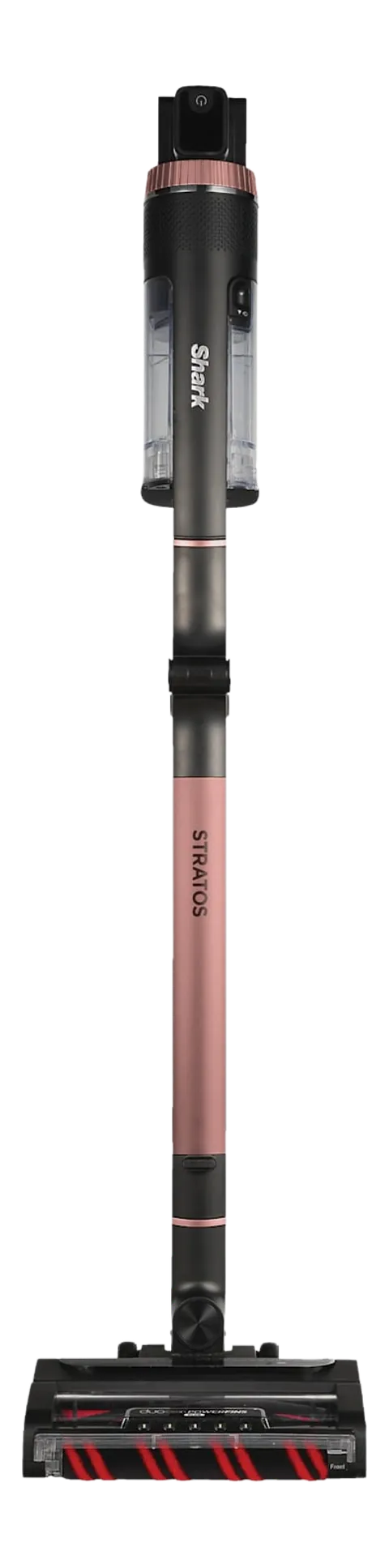
Shark
Stratos IZ400EU
Roborock
S8 MaxV Ultra
Related categories
Frequently asked questions
Does Samsung's longer runtime make the Bespoke Jet AI the better buy over the Dyson V15? +
It depends on what runs out first in your home: battery or bin. At 625 EUR the Samsung Bespoke Jet AI runs 100 minutes, 67 percent longer than the Dyson V15 Detect Absolute's 60 minutes, for only 4.3 percent less money. But the Dyson's 0.77L bin holds 54 percent more dust than Samsung's 0.50L bin, and Dyson discloses sealed HEPA filtration where Samsung's listing does not. If you clean in one long uninterrupted pass through a large or pet-heavy home, the bigger bin matters more than the extra runtime, because a vacuum that dies mid-clean is more disruptive than one you have to empty once. If you clean in shorter, room-by-room sessions, the emptied bin rarely becomes the bottleneck and Samsung's runtime and price edge win out.
Why does the cheapest model, the Shark Stratos, have such a small dust bin? +
The Shark Stratos IZ400UK is the least expensive of the four cordless stick vacuums here at 239 EUR, and its 0.19L bin is by far the smallest, less than a quarter of the Dyson V15's 0.77L capacity. That is a coherent budget trade-off rather than a hidden flaw: Shark keeps the price down and does not disclose sealed HEPA filtration either, so you are paying less and accepting more frequent bin-emptying and less-documented filtration in return. For light, frequent touch-ups it barely registers; for a full-home deep clean it means stopping to empty the bin several times over.
Is a robot vacuum like the Roborock S8 MaxV Ultra directly comparable on runtime and bin size? +
No, and forcing the comparison would be misleading. The Roborock S8 MaxV Ultra is a robot vacuum with a self-emptying dock, not a battery-limited handheld you carry room to room, so it is not meaningfully comparable to the cordless stick vacuums on either runtime minutes or bin litres. Roborock's autoEmptyDock feature is the actual answer to the question a dust bin size normally answers: the dock empties the robot automatically after each run, so the robot's own onboard bin capacity is far less relevant to how often you have to intervene.
Sources
More from the blog