Why a 9.5-Litre Air Fryer Can't Cook a 9.5-Litre Meal
Dual-basket air fryers advertise a combined total capacity, but each basket cooks alone. The number that limits your dinner is the smaller single basket.
By Nora Fischer · Last updated 19 July 2026
Researched and drafted with AI language-model assistance from CompareHomeAppliances' own verified spec database and cited public sources, per our AI-content disclosure.
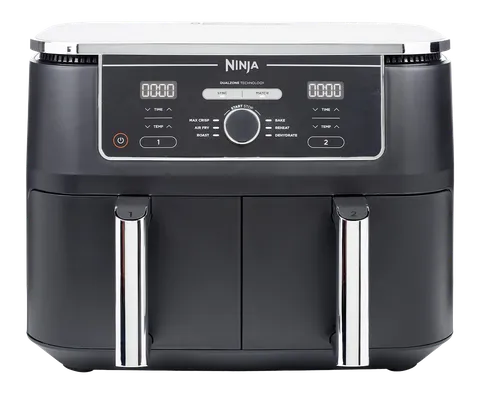
The Ninja Foodi MAX Dual Zone AF400UK advertises 9.5 litres of capacity, more than any other air fryer in our database. Cook one dish in it, a whole chicken, a full tray of roast vegetables, a big batch of fries for a party, and the real ceiling is 4.75 litres, because that 9.5 litre figure is two separate baskets added together, not one cooking space. Every dual-basket air fryer in our database works the same way: the headline number is a sum, the number that actually limits your dinner is the smaller half.
Key takeaways:
- The Ninja Foodi MAX Dual Zone AF400UK lists 9.5 litres total capacity, but each of its two baskets holds only 4.75 litres on its own, smaller than several single-basket models.
- 3 of the 5 air fryers in this comparison are dual-basket designs; their single-basket ceiling ranges from 3.25 litres (Tefal Easy Fry Grill XXL) to 4.75 litres (Ninja Foodi MAX), a 46% spread among dual-basket models alone.
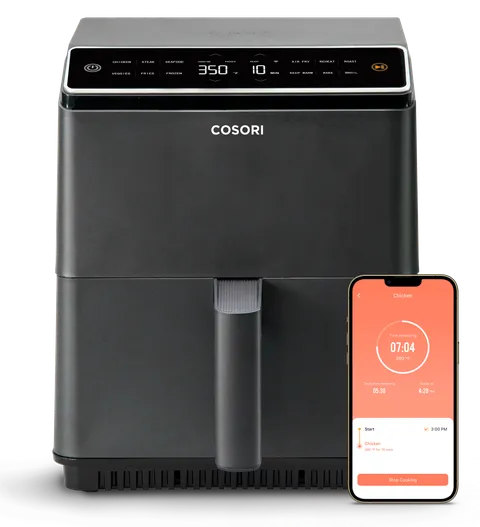
- The two single-basket models beat every dual-basket model on real one-dish capacity: Cosori’s Dual Blaze holds 6.4 litres in one basket, and the Philips Premium Airfryer XXL holds 7.3 litres, both larger than Ninja’s advertised “biggest” number once you account for how it actually splits.
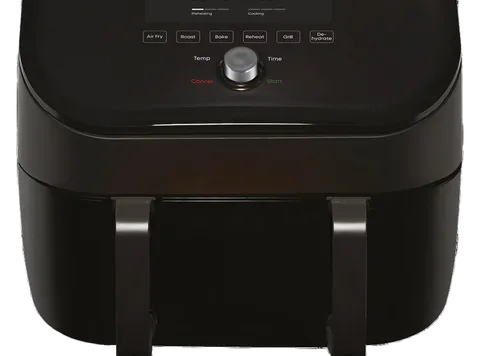
- Price does not track real capacity: the Cosori, at 144.95 EUR, has the largest confirmed single-basket capacity among the priced models, yet it costs less than both the Ninja (152.59 EUR) and the Instant Vortex (149.99 EUR).
- Dual-basket models exist to cook two different foods at two different settings at once, not to fit one large batch; a single-basket model is the better tool for one big meal.
What does “total capacity” actually mean on a dual-basket air fryer?
Manufacturers are not lying when they print a big total-litre number on a dual-basket air fryer’s box. The Ninja Foodi MAX Dual Zone AF400UK really does hold 9.5 litres of food, and the Instant Vortex 9QT VersaZone really does hold 8.5 litres. The catch is in the word “dual.” Each of these air fryers has two physically separate baskets, each with its own heating element and its own timer, so they can run fries at 200°C in one side and chicken wings at 180°C in the other, at the same time, finishing together. That is a genuinely useful feature. It is also why the two baskets can never be combined into one big space: food in basket one has no access to basket two’s air, so a single dish is capped at whatever one basket holds.
| Model | Format | Single basket | Total (combined) capacity | Price | Programs |
|---|---|---|---|---|---|
| Ninja Foodi MAX Dual Zone AF400UK | Dual-basket | 4.75 L each | 9.5 L | 152.59 EUR | 6 |
| Instant Vortex 9QT VersaZone | Dual-basket | 4.30 L each | 8.5 L | 149.99 EUR | 8 |
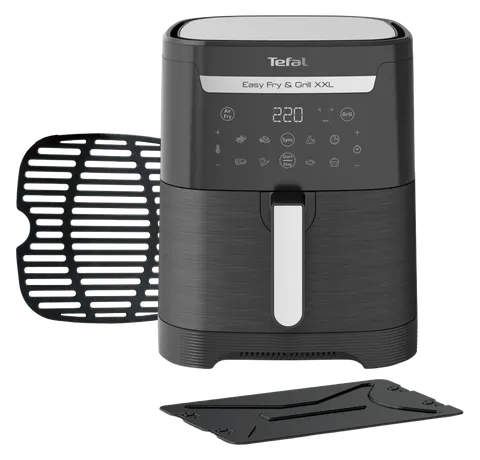
| Tefal Easy Fry Grill XXL EY801827 | Dual-basket | 3.25 L each | 6.5 L | N/A | 8 |
| Cosori Dual Blaze CAF-P583S | Single-basket | 6.4 L | 6.4 L | 144.95 EUR | 12 |
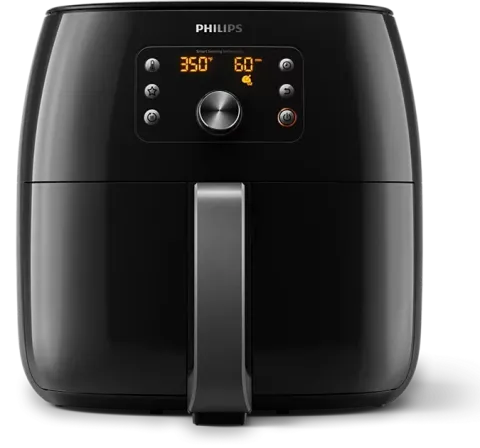
| Philips Premium Airfryer XXL HD9867/16 | Single-basket | 7.3 L | 7.3 L | N/A | N/A |
Read across the “Single basket” and “Total” columns and the pattern is immediate: for the three dual-basket models, those two numbers are never equal, because the total is always the two baskets added together. For the two single-basket models, they are the same number, because there is only one space to fill. That single “Single basket” column, not the marketing headline, is the figure that answers “will my dish fit.”
Why can’t a 9.5-litre air fryer cook a 9.5-litre meal?
Because a 9.5-litre air fryer, in the dual-basket sense, is really two 4.75-litre air fryers sharing one housing and one control panel. Put a whole chicken in one basket of the Ninja Foodi MAX and it has to fit inside 4.75 litres, the same ceiling as if you had bought a small single-basket fryer. The second basket sits empty or holds a side dish; it cannot lend its space to the first. This is not a Ninja-specific quirk. The Instant Vortex 9QT VersaZone splits its advertised 8.5 litres into two 4.30-litre baskets, and the Tefal Easy Fry Grill XXL splits its 6.5 litres into two 3.25-litre baskets, the smallest single-zone capacity of any model in this set.
That means the two air fryers with the smallest real single-dish capacity in our comparison are the Instant Vortex and the Tefal, at 4.30 litres and 3.25 litres respectively, even though both list a “total capacity” that sounds larger than plenty of single-basket fryers on the market. Even among the three dual-basket models themselves, the per-basket ceiling varies by 46% between the smallest (Tefal, 3.25 L) and the largest (Ninja, 4.75 L), so “dual-basket” alone does not tell you how big a single dish you can cook either. You still have to check the single-basket figure model by model.
When does a single big basket beat two small ones?
When the meal is one thing, not two. A whole chicken, a full tray of roasted vegetables, a big batch of fries for four people, or a large frozen pizza needs one continuous space, and that is exactly where a single-basket model wins. The Philips Premium Airfryer XXL HD9867/16 holds 7.3 litres in one basket, the largest single-dish capacity in this comparison, ahead of the Cosori Dual Blaze CAF-P583S at 6.4 litres and comfortably ahead of any of the three dual-basket models’ individual baskets. Neither the Ninja nor the Instant Vortex nor the Tefal can match that in a single zone, no matter how large their combined total looks on the box.
The dual-basket layout earns its keep in the opposite scenario: two different foods, two different settings, finishing at the same time. Fries in one basket at a higher temperature, chicken thighs in the other at a lower one, both done together, is the actual use case the “dual zone” and “VersaZone” branding is built around. It is a genuinely useful trick for a weeknight dinner with a side. It is not a trick for fitting one large item, and treating the combined total as if it were a single cooking space is the mistake this whole comparison is meant to head off.
How many litres does your household actually need?
Match the single-basket figure, not the total, to what actually lands on the tray. A single basket in the 3 to 5 litre range, which is where all three dual-basket models sit per zone, is realistically sized for 2 to 3 servings of fries, wings, or roasted vegetables at a time, which is why those models pair a modest per-basket size with the ability to run a second food alongside it. A single continuous basket nearer 6 to 7 litres, like the Cosori’s 6.4 litres or the Philips’ 7.3 litres, is sized for a bigger single batch: a whole small chicken, a full tray of vegetables for four, or fries for a crowd in one go.
If your household regularly cooks one large item, a single-basket model with the highest one-piece capacity you can afford is the more useful spec. If you regularly cook two different things at once, fries plus a protein, a dual-basket model is the better fit, and its per-basket number, not its advertised total, is what should size that decision. Either way, treat the “9.5L,” “8.5L,” or “6.5L” figure on the box as a description of the appliance’s footprint, not a promise about what one dish can weigh.
What does the data say about price versus real capacity?
Price does not track real capacity cleanly, and the Cosori is the clearest example in this set. At 144.95 EUR, it is the cheapest of the three priced models here, yet its 6.4 litre single basket is larger than the Ninja’s 4.75 litre basket (152.59 EUR) and the Instant Vortex’s 4.30 litre basket (149.99 EUR), both of which cost more. If you are shopping on real one-dish capacity per euro rather than the headline total, a well-specified single-basket model can beat a more expensive dual-basket one on the number that actually matters for a big meal.
Programs count moves in the opposite direction from what you might expect too: the Cosori offers 12 preset programs, more than either dual-basket model in this set (6 and 8), so the single-basket format is not a trade-off against convenience features here, only against cooking two different foods at once.
Before you buy, put the exact basket size you need side by side with your usual meal size in the air fryers category, and if you are torn between a dual-basket model for its two-zone convenience and a single-basket model for its bigger one-piece capacity, run both through our compare tool to see the single-basket, total-capacity, price, and program counts lined up directly against each other before you decide.
Appliances in this analysis
Cosori
Dual Blaze 6.4L Smart Air Fryer (CAF-P583S)
Instant
Vortex Plus VersaZone 8.5L Air Fryer
Ninja
Foodi MAX Dual Zone AF400EU
Philips
Premium Airfryer XXL HD9867/16
Tefal
Easy Fry & Grill XXL EY8018
Related categories
Frequently asked questions
What does total capacity actually mean on a dual-basket air fryer? +
It is the sum of two separate baskets added together, not one continuous cooking space. On the Ninja Foodi MAX Dual Zone AF400UK, the advertised 9.5 litre total is really two 4.75 litre baskets that cook independently; you can never combine them into a single 9.5 litre dish.
Is a single-basket air fryer better for a big single dish like a whole chicken or a full tray of vegetables? +
Usually, yes. A single-basket model uses its entire capacity as one continuous space. The Philips Premium Airfryer XXL HD9867/16 holds 7.3 litres in one basket, larger than any single basket in the three dual-basket models compared here, so it can fit a whole chicken or a large tray of vegetables that would not fit in either side of a dual-basket fryer.
How many litres does a household of 2 to 4 people actually need? +
Based on the basket sizes here, a single basket of roughly 4 to 5 litres cooks a realistic weeknight portion for 2 to 3 people, and a single-zone capacity nearer 6 to 7 litres, like the Cosori's 6.4 litres or the Philips' 7.3 litres, gives more room for a family batch or a bigger single dish. What matters is the number in the single basket column, not the advertised total.
Sources
More from the blog