What "AI" Actually Means on a Washing Machine, Brand by Brand
LG puts AI DD on 93% of its washing machines and marks it Nein when absent. Bosch and Siemens never say AI at all. Neither fact means what it looks like.
By Nora Fischer · Last updated 29 September 2026
Researched and drafted with AI language-model assistance from CompareHomeAppliances' own verified spec database and cited public sources, per our AI-content disclosure.
Shopping for a washing machine right now means wading through the word “AI” on some boxes and not on others, and it is easy to read too much into either. See it, and you might assume you are paying for a smarter tier. Don’t see it, and you might assume the machine is a step behind. Neither read holds up once you check the manufacturers’ own spec sheets, and the honest answer is different for every brand.
Key takeaways:
- LG puts its “AI DD” motor-control feature on 14 of the 15 washing machines we track, 93%, and its own spec-comparison table states the feature as Ja or Nein for every model, including a plain “Nein” on the one exception.
- Bosch, Siemens, Miele, AEG, Beko, Bauknecht and Grundig, 76 washing machines combined in our database, carry zero AI-branded features, yet Bosch and Siemens sell the same automatic-dosing (i-DOS) and app-connectivity (Home Connect) capability LG frames as AI-adjacent.
- Samsung markets AI under at least four different names, AI Wash, AI EcoBubble, AI Control and AI Home among them, and which ones a given model carries varies enough that no single percentage can summarize it honestly.
- Two Samsung models make the point directly: the WW7000D’s own page markets AI Wash, AI EcoBubble and AI Home together, while the WW5000C’s spec table lists only one AI-named line, AI EcoBubble with fabric recognition.
- The word “AI” on a spec sheet is not a standardized claim across brands. The named technology on that exact model’s own page is what actually tells you what you are buying.
LG: one name, checked model by model
LG is the cleanest case in this comparison, because it is the only brand where you can check the claim in both directions on the manufacturer’s own page. LG calls its feature “AI DD”, a motor-control system that reads the load and adjusts the wash motion accordingly, and every LG washing machine’s product page carries a spec-comparison table with a row literally labelled “AI DD®” and a value of “Ja” or “Nein”.
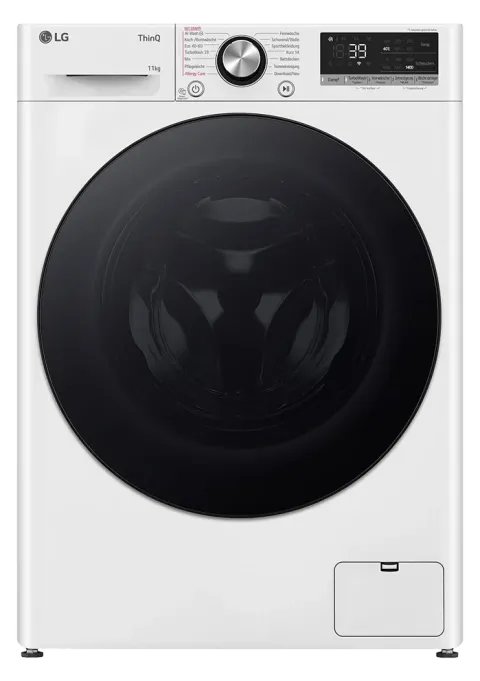
Of the 15 LG washing machines in our database, 14 carry the AI DD feature, a 93% share. The F4WR701Y is one of them, and its own spec table confirms it: AI DD, Ja. The F4WB309Y is the single exception, and its spec table states the opposite just as plainly: AI DD, Nein.
That “Nein” is worth pausing on, because it does not mean LG shipped a stripped-down machine. The F4WB309Y still has a brushless inverter motor, direct drive, a load sensor and LoadSense, plus steam and a drum-clean reminder. It simply uses a conventional direct-drive motor rather than LG’s AI-branded version of one. That is the model to keep in mind for the rest of this piece: on the machine’s own spec sheet, “AI” describes one specific, named piece of engineering, present or absent, not a tier of machine quality. Neither LG model publishes a price in our database, so this is a feature comparison only, not a price one.
Zero “AI” is not the same as zero smarts
Seven brands in our database, Bosch, Siemens, Miele, AEG, Beko, Bauknecht and Grundig, account for 76 washing machines between them, and not one carries an AI-branded feature. On the surface that reads like a gap next to LG’s 93%. It is not one, and the two brands we checked directly show why.
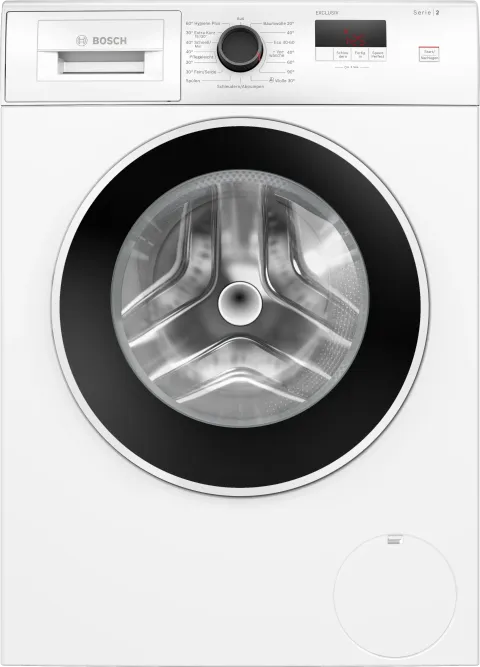
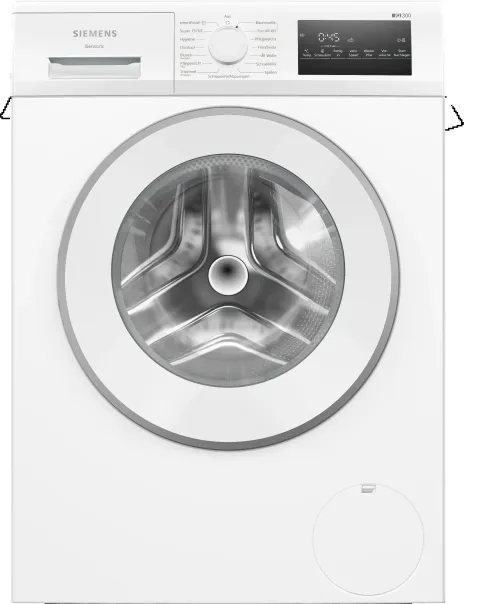
We pulled two Bosch product pages, the Serie 2 WGE02490 and the Serie 4 WAN28095, plus one Siemens page, the iQ300 WM14N22A. The word “AI” appears exactly once on each of the three pages, and every time it is the same site-wide boilerplate about an AI-generated summary of customer reviews, not a claim about the washing machine itself.
What those same pages mention heavily instead:
| Term | Bosch (2 pages) | Siemens (1 page) | What it actually is |
|---|---|---|---|
| Home Connect | 36 mentions | 29 mentions | Bosch’s and Siemens’s real smart-connectivity app |
| i-DOS / i-Dos | 3 mentions each | 3 mentions | Automatic detergent-dosing technology |
| ”AI” (machine-related) | 0 | 0 | Not used for the appliance itself |
Home Connect is a genuine connected-appliance app, and i-DOS is a genuine automatic-dosing system that reads the load and meters detergent to it, conceptually close to what LG’s AI DD does for wash motion. Bosch and Siemens simply never reach for the word “AI” to describe it. Miele’s own database record backs the same pattern from a different angle: its 12 tracked washing machines carry no AI tag either, but the features.digital field for those models is genuinely populated with other varied, model-specific tags, child lock, energy forecast, touch display, rather than sitting empty. That is a brand that names its smart features differently, not a brand that lacks them. A zero on the AI-branded chart above is a vocabulary fact, not a capability fact.
Samsung: one word, several different features
Samsung is the case where a single percentage would actively mislead you, so this section stays qualitative on purpose. Samsung uses “AI” as an umbrella term that covers at least four separately named sub-features, AI Wash, AI EcoBubble, AI Control and AI Home among them, and different models carry different combinations depending on generation and trim. Unlike LG’s single, consistently named AI DD, there is no one AI feature at Samsung to count present or absent.
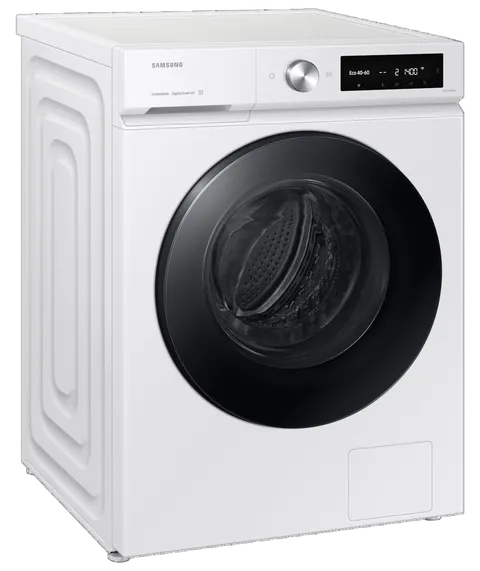
Two of Samsung’s own product pages make the spread concrete. The WW7000D markets AI Wash, AI EcoBubble and AI Home together, with dozens of AI-related mentions across its marketing copy and spec table. The WW5000C, one trim down, lists only a single AI-named line in its spec table, “AI Ecobubble™ mit Textilerkennung”, AI EcoBubble with fabric recognition. Same brand, same word on both pages, genuinely different feature sets underneath it.
That is the trap specific to Samsung. Seeing “AI” on a Samsung spec sheet confirms almost nothing about which capability you are getting until you read the actual named line. It is a different situation from LG, where one model either has AI DD or the page says Nein, full stop.
What to actually check before you buy
Across all three brand groups, the useful habit is the same one: stop reading “AI” as a single, comparable claim, and go find the specific named technology on that exact model’s own manufacturer page. For LG that means checking the AI DD row in the spec table. For Bosch and Siemens it means looking at whether the model has i-DOS or Home Connect, since those do the equivalent job under a different name. For Samsung it means reading which of AI Wash, AI EcoBubble, AI Control or AI Home that particular model’s page actually lists, not just whether the letters “AI” appear somewhere on it. If you are weighing two washing machines against each other, that model-level spec line, not the marketing word above it, is the one that tells you what you are actually paying for.
Appliances in this analysis
LG
F4WB309Y
LG
F4WR701Y (AI DD, TurboWash 360)
Bosch
Serie 2 WGE02490
Siemens
iQ300 WM14N22A
Samsung
WW9BDB7U34GWU2
Samsung
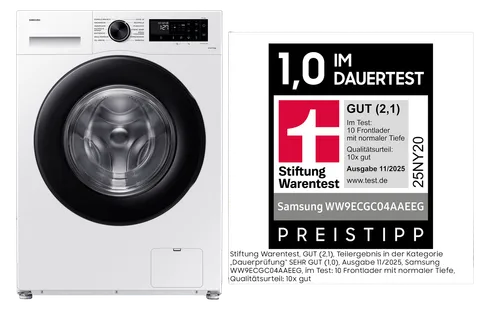
WW9ECGC04AAEEG
Related categories
Frequently asked questions
Does a washing machine without an "AI" label mean it is an older or dumber machine? +
No. Bosch and Siemens never use the word AI on their washing machine product pages, yet both sell current-generation machines with automatic dosing (i-DOS) and a full smart-connectivity app (Home Connect). The absence of the word AI tells you about a brand's marketing vocabulary, not about the machine's actual capability.
What does LG's "AI DD" actually mean, and how do I check if a specific model has it? +
AI DD is LG's name for a motor-control system that reads the load and adjusts the wash motion to it. LG's own product pages carry a spec-comparison table with a row literally labelled AI DD and a value of Ja or Nein for that exact model, so you do not have to guess from the model name or the marketing copy. Check that row on the specific model's own page.
Is "AI" on a Samsung washing machine one single feature? +
No, and this is the one place the word is genuinely confusing. Samsung uses AI as an umbrella over several separately named features, including AI Wash, AI EcoBubble, AI Control, AI Energy Mode and AI Home, and different models carry different combinations of them. Seeing the word AI on a Samsung spec sheet does not tell you which of those you are actually getting. Read the specific named feature on that model's own page.
Should I pay more for an "AI" model, or treat it as a paywalled tier? +
Neither assumption holds up brand to brand. At LG, AI DD is standard on the large majority of the current lineup, not a rare premium add-on. At Bosch and Siemens, there is no AI tier to pay for at all, because the equivalent capability is sold under a different name (i-DOS, Home Connect). Check the named technology on the exact model you are comparing rather than assuming the word AI marks a price step.
Sources
More from the blog