What the 920-Euro Oven Premium Actually Buys
The two priced ovens in our database sit 920 euros apart. That premium buys a steam function and telescopic runners, not efficiency, heat, or a probe.
By Nora Fischer · Last updated 20 July 2026
Researched and drafted with AI language-model assistance from CompareHomeAppliances' own verified spec database and cited public sources, per our AI-content disclosure.
Only two of the five built-in ovens we track publish a price at all: the Bosch Series 8 HBG7784B1 at 1,349 euros and the Miele H 7264 BP at 2,269 euros. That is a 920-euro gap, 68 percent more for the Miele. What that premium buys is specific: a steam function, telescopic shelf runners, and 5 litres more cavity space. What it does not buy is more heat (both top out at 300°C), different cleaning (both are pyrolytic), or a better energy class (both A+). And the honest twist is that the cheaper Bosch publicly lists more, not less: 14 heating functions and a meat probe, figures the Miele’s own datasheet simply does not disclose.
Key takeaways:
- Only 2 of the 5 built-in ovens in our database publish a price: the Bosch Series 8 HBG7784B1 at 1,349 euros and the Miele H 7264 BP at 2,269 euros, a 920-euro (68 percent) gap.
- All five ovens carry the same A+ energy class on the pre-2021 EU oven scale (Regulation 65/2014), so the label separates none of them.
- The 920-euro premium on the Miele buys a steam function, telescopic shelf runners, and 5 litres more cavity (76 versus 71 litres); it does not buy more heat (both reach 300°C) or different cleaning (both pyrolytic).
- The cheaper Bosch publicly lists 14 heating functions and a meat probe; the Miele’s public datasheet lists neither figure.
- Among the three ovens that disclose a heating-function count, the range is 10 (AEG) to 14 (Bosch); the dearest oven, the Miele, does not publish this number at all.
Which ovens even publish a price?
Of the built-in ovens we track, only the Bosch Series 8 HBG7784B1 and the Miele H 7264 BP list a price on their own manufacturer pages. The AEG 6000 SenseCook, the Neff N70, and the Samsung Series 4 Dual Cook all show N/A for price, because their manufacturers do not publish an RRP the way Bosch and Miele do.
That thins the comparison to a single pair, which is worth saying plainly rather than papering over. We will not fake a price for the other three to make a cleaner chart. A two-oven price comparison is a real finding, just a narrow one: it tells you what one specific 920-euro step costs, not what price buys across the whole market. Use the running-cost tool and the compare page to line up the three unpriced models against whatever local retail figure you find, since we cannot certify a number the manufacturer itself does not publish.
What does the 920 euros actually buy?
Stack the Bosch and the Miele side by side and the gap resolves into three concrete items. The Miele adds a steam function, neither oven listed by the Bosch nor available on it. It adds telescopic shelf runners, meaning the shelf glides out on rails instead of you reaching a hand into a hot cavity to lift a tray. And it adds 5 litres of cavity space, 76 litres against the Bosch’s 71.
That is what 920 euros buys: three specific, nameable things, not a general upgrade. Framed as a percentage, 68 percent more money buys one cooking mode, one convenience fitting, and roughly 7 percent more interior volume. Whether that trade is worth it depends entirely on whether you will use steam-assisted baking regularly and whether pulling a hot shelf out by hand already bothers you. If neither matters to your kitchen, the 920 euros is buying you very little.
Why the cheaper oven lists more on paper
Here is where the story gets more interesting than a simple “you get what you pay for” line. The Bosch, the cheaper of the two, publicly lists 14 heating functions and a meat probe. The Miele’s public datasheet discloses neither figure.
Be careful how you read that gap. This is a disclosure difference, what each brand chooses to put on its public spec sheet, not proof the Miele lacks a probe or runs fewer modes. Miele ovens are commonly sold with a probe accessory and multiple cooking programs in the German market; the datasheet we can cite simply does not spell out a count. We report only what is published, so until a verifiable figure appears, the honest entry is N/A, not a guess and not a zero.
The practical upshot: if a specific published number, 14 modes, a named probe, matters to your decision, the Bosch currently gives you that on paper and the Miele does not. If you are choosing on what you can personally verify at the point of sale rather than what is typed on a spec sheet, ask the retailer directly about the Miele’s functions and probe compatibility before assuming the gap is real.
What every one of these ovens shares
Before the differences run away with the story, it is worth naming what does not change across any of the five. Every oven here is 60 cm wide, a single electric cavity, built in, and rated A+ on the pre-2021 EU oven energy scale under Regulation 65/2014. Read that letter like a school grade that only ranks its own class: an A+ oven and an A+ dryer never sat the same exam, and inside this set, the A+ letter separates none of the five ovens from each other at all. That is exactly why price and features, not the label, are doing the real work in this decision.
| Oven | Price | Energy class | Cavity | Heating functions | Max temp | Cleaning | Steam | Meat probe | Telescopic runners |
|---|---|---|---|---|---|---|---|---|---|
| Bosch Series 8 HBG7784B1 | 1,349 € | A+ | 71 L | 14 | 300 °C | Pyrolytic | No | Yes | No |
| Miele H 7264 BP | 2,269 € | A+ | 76 L | N/A | 300 °C | Pyrolytic | Yes | N/A | Yes |
| AEG 6000 SenseCook | N/A | A+ | 71 L | 10 | 300 °C | Pyrolytic | No | Yes | N/A |
| Neff N70 B57CR22N0B | N/A | A+ | 71 L | 12 | 200 °C | Pyrolytic | No | No | No |
| Samsung Series 4 Dual Cook | N/A | A+ | 76 L | N/A | 250 °C | Catalytic | N/A | N/A | N/A |
N/A means the manufacturer’s public datasheet does not disclose the figure; we never fill a blank with a zero.
Look past the two priced models and two more real differences surface. The Neff N70 tops out at 200°C, a full 100 degrees below the Bosch and Miele’s 300°C ceiling, which matters if you regularly push a recipe that calls for a very hot oven. And the Samsung Series 4 is the only oven in the set that is catalytic rather than pyrolytic: its liner absorbs grease during ordinary cooking instead of burning it to ash in a dedicated high-heat cycle, a real difference in how you maintain it, not just a spec-sheet footnote.
So who should pay the premium?
Pay the extra 920 euros for the Miele H 7264 BP if you specifically want steam-assisted cooking and telescopic runners, and you know you will use both. That is what the money buys, cleanly and verifiably. Choose the Bosch Series 8 HBG7784B1 if you want the widest published feature count for less money: 14 heating functions and a meat probe, both listed in black and white, at 1,349 euros.
Nobody is buying efficiency with this gap. Both ovens sit at A+, both hit 300°C, both self-clean the same way. We looked at this same Bosch-versus-Miele pair from the energy side in an earlier piece on the price and energy-efficiency gap, and the conclusion there was the same: the euros are not buying a lower bill. If a running-cost number ever gets published for either oven, run it through the running-cost tool to see what it means in a year of use, and use the compare page to set any two ovens in this piece side by side before you decide.
Appliances in this analysis
Bosch
Series 8 HBG7784B1
Miele
H 7264 BP
AEG
6000 SenseCook OS6PB50AM
Neff
N70 B57CR22N0B
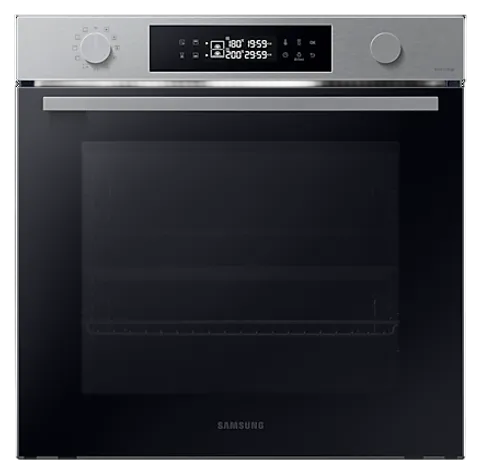
Samsung
Series 4 Dual Cook NV7B44205AS
Related categories
Frequently asked questions
Do more expensive ovens use less energy? +
Not in our data. All five built-in ovens we track are rated A+ on the EU oven scale (Regulation 65/2014), and the two that publish an energy-per-cycle figure sit at 0.69 and 0.71 kWh. The 920-euro gap between the priced Bosch and Miele buys features, not efficiency.
What does a steam function add to an oven? +
Steam assists baking for crustier bread and moister roasts, and it feeds some gentler cleaning cycles. In our set only the Miele H 7264 BP publishes a steam function, and it is one of the concrete things its higher price buys over the Bosch.
What is the difference between pyrolytic and catalytic cleaning? +
Pyrolytic self-cleaning burns residue to ash at very high heat in a dedicated cycle. Catalytic liners absorb grease during normal cooking. Four of our five ovens are pyrolytic; the Samsung Series 4 is catalytic.
Why do some ovens show N/A for heating functions or price? +
Because the manufacturer's public datasheet does not disclose that figure. We record only published specs and never substitute a zero for a missing value, so the Miele shows N/A for heating functions even though it is the most expensive oven in the set.
Sources
- Bosch Series 8 HBG7784B1 specification sheet (PDF)
- Neff N70 B57CR22N0B specification sheet (PDF)
- Samsung Series 4 Dual Cook NV7B44205AS product page
- Regulation (EU) 65/2014 - energy labelling of domestic ovens (EUR-Lex)
- Regulation (EU) 66/2014 - ecodesign of domestic ovens, hobs and range hoods (EUR-Lex)
More from the blog