A Small Wine Cooler Costs Up to 18 Times More Per Bottle
A bigger wine cooler does not cost more to run: a 229-bottle Miele uses less electricity per year than a 15-bottle AEG. Per bottle, the gap is 18 times.
By Nora Fischer · Last updated 25 September 2026
Researched and drafted with AI language-model assistance from CompareHomeAppliances' own verified spec database and cited public sources, per our AI-content disclosure.
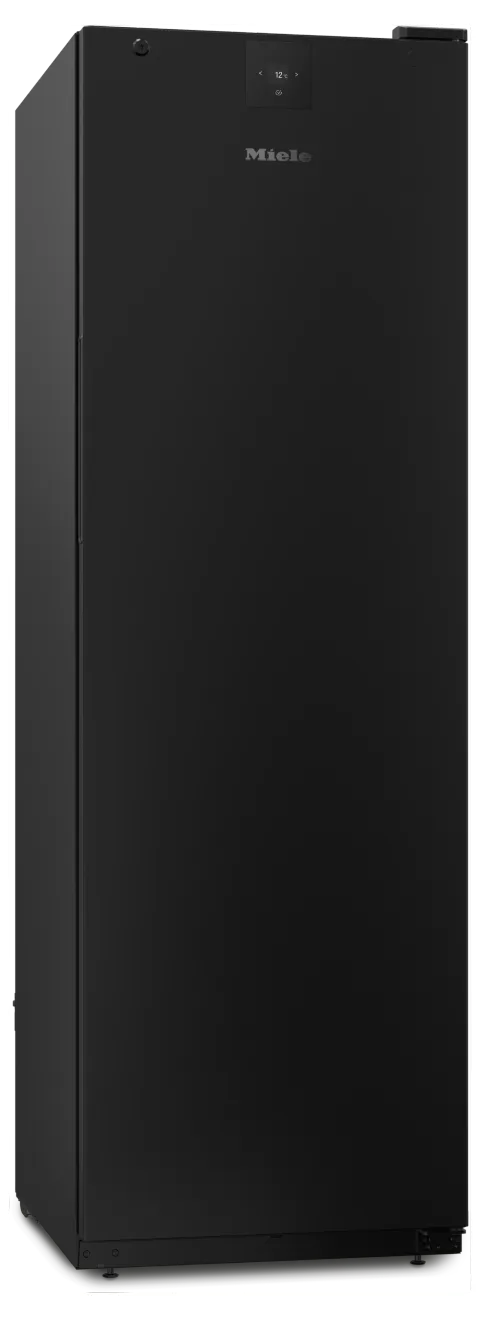
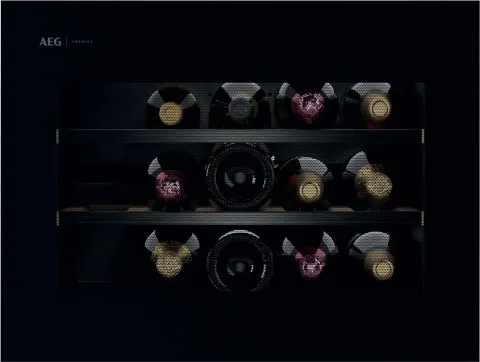
A bigger wine cooler does not cost more to run. Across 18 wine coolers, declared annual electricity use only moves from 95 to 162 kWh, a factor of 1.7, while capacity runs from 15 to 229 bottles, a factor of 15. So the energy each bottle costs you swings from 0.42 to 7.72 kWh a year, 18 times. The Miele KWT 4584 E holds 229 bottles and declares 95.36 kWh a year. The AEG CW6000B holds 15 bottles and declares 100 kWh. The big one uses less power and costs 38.14 EUR a year to run against 40 EUR, at 0.40 EUR per kWh.
Key takeaways:
- Annual energy barely follows size: 95 to 162 kWh across 18 wine coolers (1.7 times) while capacity spans 15 to 229 bottles (15 times).
- The 229-bottle Miele KWT 4584 E (95.36 kWh, 38.14 EUR a year) uses less electricity than the 15-bottle AEG CW6000B (100 kWh, 40 EUR a year).
- Per bottle, coolers of 15 to 21 bottles average 6.52 kWh a year, mid-size ones 3.20 kWh and coolers of 80 to 229 bottles 1.00 kWh.
- In absolute euros the gap is small: band averages run from about 46 to 57 EUR a year, roughly 11 EUR between smallest and largest.
- Sticker price matters more than running cost: the cheapest cooler in the set costs 1,209 EUR, the 229-bottle Miele 2,039 EUR.
Why does a 15-bottle cooler use as much power as a 229-bottle one?
A wine cooler spends most of its energy fighting heat leaking in through the walls and door, and running a compressor or thermoelectric cell at all. Adding shelves does not multiply that fixed cost. That is the sense-making version of the table below: the electricity bill is set mostly by insulation, glass door and cooling design, and only weakly by how many bottles fit inside.
Group the 18 coolers by size and the pattern is steady. The small ones are not frugal in any way that matters, they simply spread a similar bill over far fewer bottles.
| Size band | Models | Mean kWh per year | Mean cost per year (0.40 EUR/kWh) | Mean kWh per bottle | Mean cost per bottle-year |
|---|---|---|---|---|---|
| Small, 15 to 21 bottles | 6 | 115.5 | 46 EUR | 6.52 | 2.61 EUR |
| Mid, 33 to 52 bottles | 7 | 135.2 | 54 EUR | 3.20 | 1.28 EUR |
| Large, 80 to 229 bottles | 5 | 142.3 | 57 EUR | 1.00 | 0.40 EUR |
The 0.40 EUR per kWh is the running-cost assumption our running-cost tool uses. Change it to your own tariff and every euro figure here scales in proportion.
How do individual models compare?
Bottle counts are the makers’ figures in 0.75 L Bordeaux bottles, and annual energy is the declared EU label value. The Miele figures come from Miele’s own product pages via our database, and the Bosch and AEG ones from their manufacturer pages and EU label documents listed at the end.
| Model | Bottles | kWh per year | kWh per bottle | Class | Type |
|---|---|---|---|---|---|
| Miele KWT 4584 E | 229 | 95.36 | 0.42 | E | Freestanding |
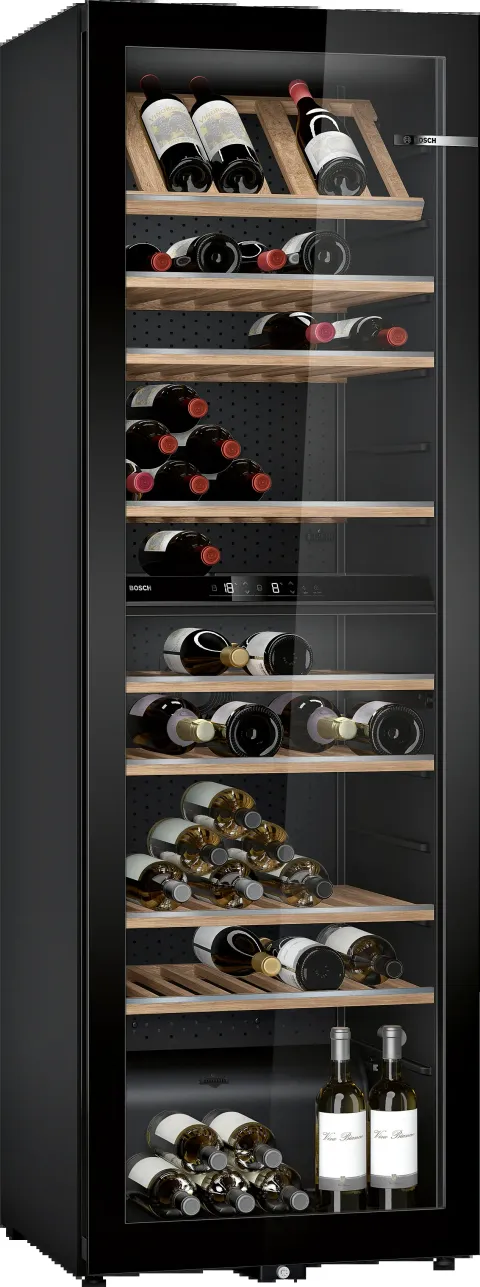
| Bosch KWK36ABGA | 199 | 155 | 0.78 | G | Freestanding |
| Miele KWT 4999 F | 146 | 144.18 | 0.99 | F | Freestanding |
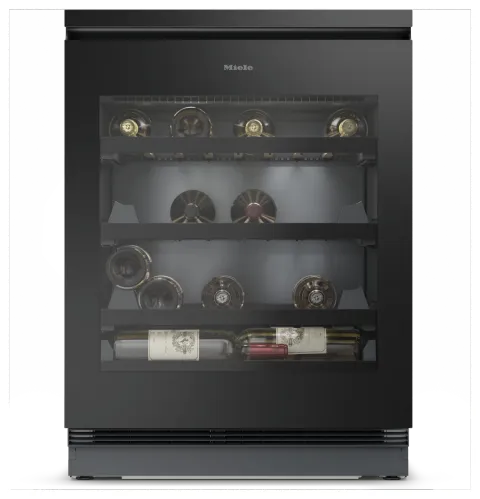
| Miele KWTUS 7054 F | 44 | 106.2 | 2.41 | F | Undercounter |
| Bosch KUW21AHG0 | 44 | 130 | 2.95 | G | Built-in |
| Miele KWT 6422 IG-1 | 33 | 143 | 4.33 | G | Built-in |
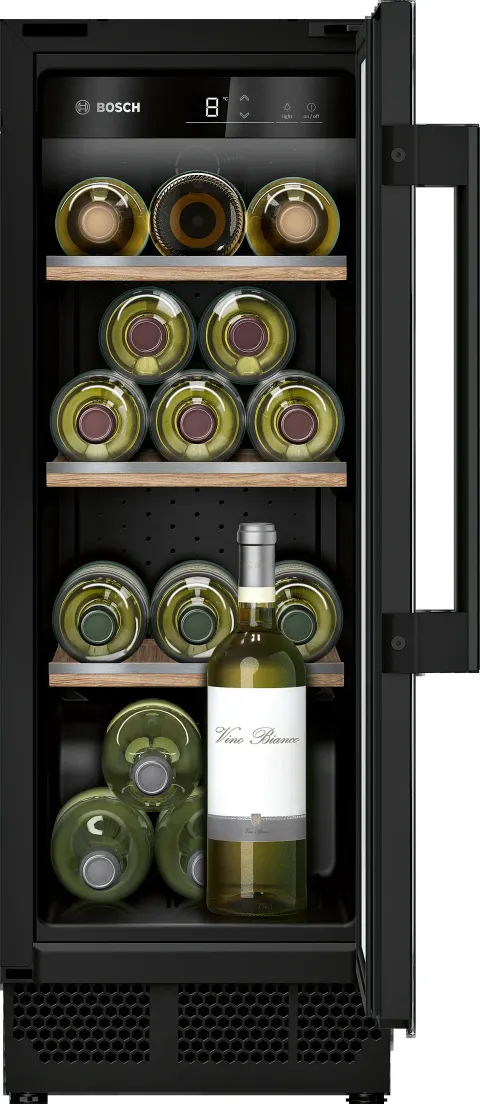
| Bosch KUW20VHF0 | 21 | 100 | 4.76 | F | Built-in |
| AEG CW6000B | 15 | 100 | 6.67 | F | Built-in |
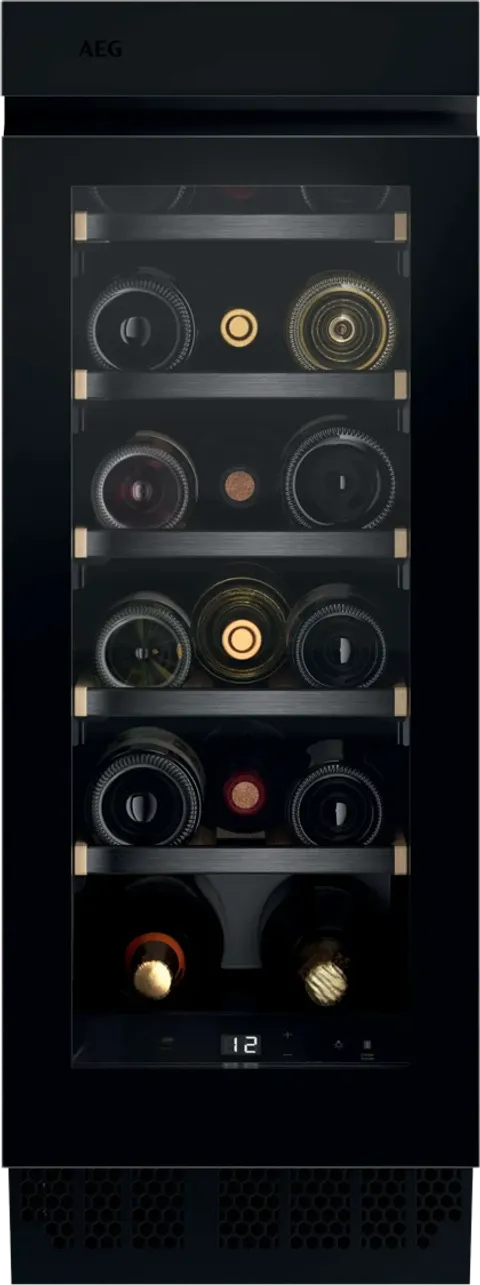
| AEG 7000 NSW8S823GT | 18 | 139 | 7.72 | G | Built-in |
The table shows 9 of the 18 coolers, chosen to span the range. One more deserves a mention because it sits at the top of the annual energy scale: the built-in Miele KWT 6722 IS-1 holds 80 bottles and declares 162 kWh, the highest of all 18, at 4,899 EUR and class G. Only one cooler of the 18 reaches class E, the Miele KWT 4584 E above. Ten are class G and seven are class F.
Bars scaled to 0 to 8 kWh per bottle per year, sorted from lowest to highest. Annual kWh is the declared EU label value divided by rated bottle capacity. The highlighted bar is the Miele KWT 4584 E, the lowest of all 18 coolers.
Does the energy class letter help here?
Less than you would hope. The letter is category-scoped: it grades wine coolers on the EU A to G scale against a size-adjusted reference, and it must never be compared with a fridge or freezer. Inside wine coolers it still says little about cost per bottle. The F-rated 15-bottle AEG CW6000B spends 6.67 kWh per bottle, sixteen times the E-rated Miele’s 0.42, and the letter gap between them is two steps. For the wider picture on what the letters mean across appliance types, see our piece on what energy class really means across appliances. For wine coolers, read the annual kWh and the bottle count, and ignore the letter until you have done that.
Is a small cooler a bad deal to run?
Not in euros. A cooler of 15 to 21 bottles averages 46 EUR a year in electricity in our data, and a large one 57 EUR. The 11 EUR a year between them will not decide anything. The per-bottle figure matters only if you already own a large collection and are asking how efficiently the box holds it, and for that the large freestanding units win clearly. Built-in units are the reason the small end looks poor: all built-in coolers in this set hold 52 bottles or fewer except the 80-bottle Miele KWT 6722 IS-1, because a 60 cm niche caps the size. You pay in efficiency per bottle for the convenience of the cabinet, and we looked at what that convenience costs in purchase price in our Bosch built-in versus freestanding comparison.
Should you buy a bigger cooler to cut the cost per bottle?
No. Do not buy capacity you will not fill: an empty shelf earns you nothing and the price gap is large. The cheapest cooler in the set, the Bosch KUW20VHF0, costs 1,209 EUR. The 229-bottle Miele KWT 4584 E costs 2,039 EUR, 830 EUR more, and at the roughly 11 EUR a year average running difference you would never earn that back in electricity. Use these rules instead:
- Fewer than about 20 bottles: buy a small cooler. Per-bottle running cost is around six times a large unit’s, but the absolute bill is only about 46 EUR a year.
- 30 to 50 bottles: expect 54 EUR a year on average and check the individual kWh figure, since the Miele KWTUS 7054 F at 106.2 kWh sits well below the Miele KWT 6422 IG-1 at 143 kWh at similar sizes.
- 100 bottles or more: freestanding units are the efficient end, but pick by declared kWh. The 199-bottle Bosch KWK36ABGA declares 155 kWh, well above the Miele KWT 4584 E at 95.36 kWh.
Browse the full wine cooler category and turn any kWh figure into a yearly cost with the running-cost tool.
What are the limits of this comparison?
The finding rests on 18 wine coolers from Bosch, Siemens, Miele and AEG, half of them built-in units. The energy figures are the manufacturers’ declared label values, not our own measurements, and real consumption depends on room temperature, how often you open the door and how many zones you run. The per-bottle figures use the makers’ Bordeaux-bottle capacity, which is optimistic if you store wider bottles. What holds across every cut is the direction: size moves the electricity bill a little and the cost per bottle a lot.
Appliances in this analysis
Miele
KWT 4584 E
AEG
CW6000B
Bosch
Serie 6 KUW20VHF0
Bosch
Serie 6 KWK36ABGA
Miele
KWTUS 7054 F
AEG
7000 NSW8S823GT
Related categories
Frequently asked questions
Does a bigger wine cooler use more electricity? +
Only slightly. Across 18 wine coolers, declared annual energy ranges from 95 to 162 kWh, a factor of 1.7, while bottle capacity ranges from 15 to 229, a factor of 15. The 229-bottle Miele KWT 4584 E declares 95.36 kWh a year, less than the 15-bottle AEG CW6000B at 100 kWh.
How much does it cost to run a wine cooler for a year? +
At 0.40 EUR per kWh, the size-band averages are about 46 EUR a year for coolers holding 15 to 21 bottles, 54 EUR for 33 to 52 bottles and 57 EUR for 80 to 229 bottles. The whole spread between the smallest and largest band is roughly 11 EUR a year.
Should I buy a bigger wine cooler to lower the cost per bottle? +
No. Buy for the number of bottles you will really store. Per bottle, a large cooler is far cheaper to run, but in absolute euros a small one costs only about 46 EUR a year, and sticker price dominates: the smallest cooler in our data costs 1,209 EUR against 2,039 EUR for the 229-bottle Miele.
Does the energy class letter tell me the running cost per bottle? +
No. The A to G letter grades absolute annual consumption against a size-adjusted reference for wine coolers only, so it says little about cost per bottle. Two coolers with the same letter can differ several times over in kWh per bottle purely because of size. Compare the annual kWh figure and the bottle count instead.
Sources
More from the blog